
Governing Space by Exception: Neoliberal Reason and the Recentralization of Urban Decision-Making in Morocco: A Hermeneutic and Documentary Analysis of the Urban Planning Derogation Regime (Laws No. 47-18 and No. 22-24)
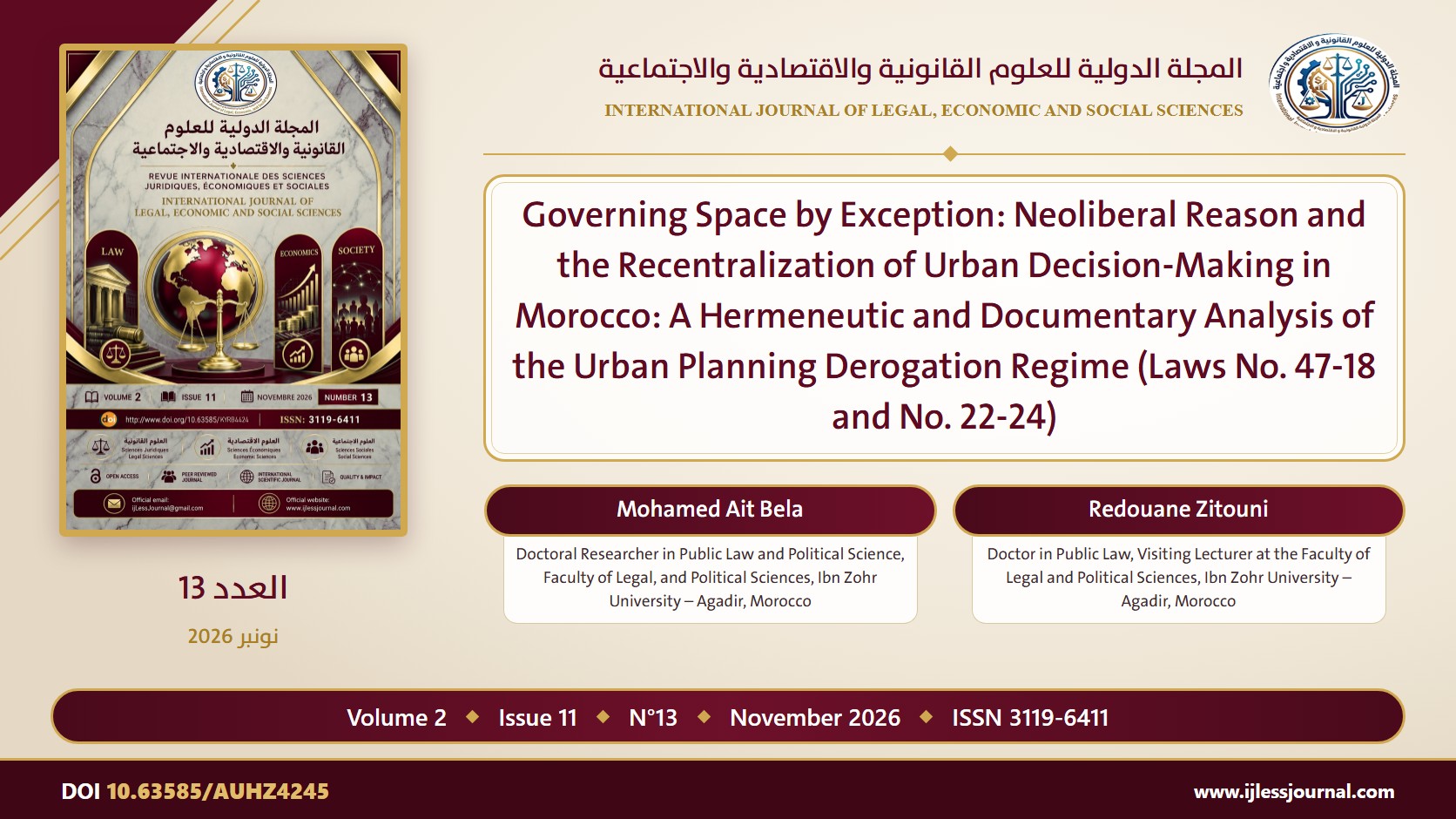
Governing Space by Exception: Neoliberal Reason and the Recentralization of Urban Decision-Making in Morocco: A Hermeneutic and Documentary Analysis of the Urban Planning Derogation Regime (Laws No. 47-18 and No. 22-24)
حُكم المجال بالاستثناء: العقلانية النيوليبرالية وإعادة تمركز القرار الحضري بالمغرب – تحليل هرمينوطيقي ووثائقي لنظام الاستثناء في مجال التعمير (القانونان رقم 47.18 ورقم 22.24)
DOI https://doi.org/10.63585/AUHZ4245
معلومات البحث
| Journal | International Journal of Legal, Economic, and Social Sciences (IJLESS) المجلة الدولية للعلوم القانونية والاقتصادية والاجتماعية |
|---|---|
| Volume / Issue / N° | 2 / 11 / 13 |
| Publication | November 2026 |
| Pages | 470–495 |
| DOI | https://doi.org/10.63585/AUHZ4245 |
| Issue DOI | https://doi.org/10.63585/KYRB4424 |
| ISSN | 3119-6411 |
| Language | en |
| License | CC BY 4.0 |
Abstract
Moroccan urban planning law rests on a classical promise: the uses of urban land are fixed in advance by a general and binding plan, adopted in the name of a public interest that passes, however briefly, through territorial deliberation and public inquiry. This article examines how the derogation regime instituted by Law No. 47-18 on Regional Investment Centres (2019) and recast by Law No. 22-24 (2024) reconfigures that promise. Combining the political economy of space, Foucauldian analyses of neoliberal reason and the literature on neoliberal bureaucratization and authoritarian neoliberalism, it develops a hermeneutic reading of the legal texts in three moments (lexical, intertextual and genealogical) and confronts it with a documentary corpus: the parliamentary record of Law No. 22-24, royal speeches and letters on investment governance, the Economic, Social and Environmental Council's study of 13,222 derogation files, a Court of Accounts evaluation and the activity reports of the regional investment centres. Three displacements emerge. The source of spatial normativity shifts from the plan to the investment project; the power to grant exceptions moves from the regional level to the Head of Government, within a dual executive whose strategic orientations are set by royal directives; and the public interest is redefined negatively, as a residual list of land that no exception may cover. The regime is not a deregulation but a re-regulation for the market, marked by a proliferation of procedures and by the statistical invisibility of the exceptions themselves. The article proposes the concepts of procedural recentralization and residual public interest to account for this configuration.
Keywords: neoliberalism; urban planning derogations; executive centralization; legal hermeneutics; regional investment centres; advanced regionalization; public interest; Morocco.
الملخص
يقوم قانون التعمير بالمغرب على وعدٍ كلاسيكي مفاده أن استعمالات الأرض الحضرية تُحدَّد سلفاً بواسطة تصميم تهيئة عام وملزم، يُعتمد باسم مصلحة عامة تمرّ، ولو بصورة وجيزة، عبر التداول الترابي والبحث العلني. ويتناول هذا المقال الكيفية التي يُعيد بها نظام الاستثناء في مجال التعمير، كما أرساه القانون رقم 47.18 المتعلق بإصلاح المراكز الجهوية للاستثمار وبإحداث اللجان الجهوية الموحدة للاستثمار (2019)، وأعاد تشكيله القانون رقم 22.24 (2024)، صياغةَ هذا الوعد. ومن خلال الجمع بين الاقتصاد السياسي للمجال، والتحليل الفوكوي للعقلانية النيوليبرالية، وأدبيات البيروقراطية النيوليبرالية والنيوليبرالية السلطوية، يقترح المقال قراءة هرمينوطيقية للنصوص القانونية في ثلاث لحظات (معجمية، وتناصّية، وجينيالوجية)، يضعها في محكّ متنٍ وثائقي يشمل: المسار التشريعي للقانون رقم 22.24، والخطب والرسائل الملكية المؤطرة لحكامة الاستثمار، ورأي المجلس الاقتصادي والاجتماعي والبيئي المستند إلى دراسة 13.222 ملف استثناء، وتقييم المجلس الأعلى للحسابات لتجربة المراكز الجهوية للاستثمار، وحصيلة أنشطة هذه المراكز. ويكشف التحليل عن ثلاث إزاحات: انتقال مصدر المعيارية المجالية من تصميم التهيئة إلى المشروع الاستثماري؛ وانتقال سلطة منح الاستثناء من المستوى الجهوي إلى رئيس الحكومة، في إطار ثنائية السلطة التنفيذية، حيث تُحدَّد التوجهات الاستراتيجية لسياسة الدولة بموجب التوجيهات الملكية؛ وإعادة تعريف المصلحة العامة تعريفاً سلبياً بوصفها قائمة حصرية متبقّية من الأراضي التي لا يجوز أن يشملها الاستثناء. ومن ثمّ، فإن هذا النظام لا يُمثّل رفعاً للقيود التنظيمية (dérégulation)، بل إعادةَ تقنينٍ لصالح السوق (re-régulation)، تتّسم بتكاثر المساطر وباحتجاب قرارات الاستثناء عن المعطيات المنشورة. ويقترح المقال مفهومي "إعادة التمركز المسطري" و"المصلحة العامة المتبقّية" لتفسير هذه التشكيلة.
طريقة الاستشهاد | Citation
APA
Mohamed Ait Bela، Redouane Zitouni (2026). Governing Space by Exception: Neoliberal Reason and the Recentralization of Urban Decision-Making in Morocco: A Hermeneutic and Documentary Analysis of the Urban Planning Derogation Regime (Laws No. 47-18 and No. 22-24). المجلة الدولية للعلوم القانونية والاقتصادية والاجتماعية (IJLESS)، 2(11)، 470–495. https://doi.org/10.63585/AUHZ4245
English
Mohamed Ait Bela، Redouane Zitouni (2026). Governing Space by Exception: Neoliberal Reason and the Recentralization of Urban Decision-Making in Morocco: A Hermeneutic and Documentary Analysis of the Urban Planning Derogation Regime (Laws No. 47-18 and No. 22-24). International Journal of Legal, Economic, and Social Sciences, 2(11), 470–495. https://doi.org/10.63585/AUHZ4245
Chicago
Mohamed Ait Bela، Redouane Zitouni. “Governing Space by Exception: Neoliberal Reason and the Recentralization of Urban Decision-Making in Morocco: A Hermeneutic and Documentary Analysis of the Urban Planning Derogation Regime (Laws No. 47-18 and No. 22-24).” International Journal of Legal, Economic, and Social Sciences 2, no. 11 (2026): 470–495. https://doi.org/10.63585/AUHZ4245.
تحميل البحث
CC BY 4.0 — هذا البحث منشور في وصول مفتوح بموجب رخصة المشاع الإبداعي نَسب المُصنَّف 4.0 دولي (CC BY 4.0).